

The Trainspotter's Guide to the Anthropocene - NC500 edition
History of the Hydrail in the North
It seems like it was only yesterday since Scotland said "Go!" to H20 and the Hydrail fleet was established across the country to benefit from the boundless natural resources of the North Sea. We are now in an era where direct carbon emissions have become a thing of the past for rail travel.
Scottish Hydrail was set up as a nationalised rail company in 2040 and this year mark's the 10th anniversary of this revolutionary mode of transport. This month we bring you a travel-log from the North on the first alternative to diesel power - The Flying Selkie - a passenger train based on hydrogen technology.
What's on board?
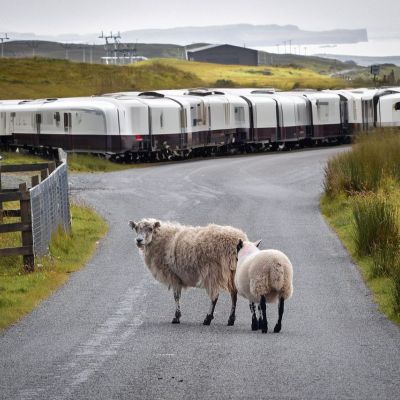
As The Flying Selkie glides silently across the vast landscapes along the NC500, it leaves only water vapour in its wake, adding a new dimension to travel and tourism which leaves no trace. Its aerodynamic design, crafted from lightweight composite materials, minimizes energy consumption while maximizing speed, reaching 350 km/h effortlessly.
Onboard, passengers experience luxurious, eco-friendly services. Smart glass windows automatically adjust tint based on sunlight, while augmented reality screens display real-time information about passing landmarks including the UNESCO World Heritage site at Forsinard Flows the largest area of untouched blanket bog in the world.
Spacious cabins offer personal climate control, ergonomic seating, and customizable lighting, ensuring comfort. Dining cars serve gourmet meals crafted from sustainable, locally sourced ingredients, while AI concierges cater to personalized preferences for onward travel using the extensive network of E-bikes and electric vehicles that are situated at each Hydrarail station in the North.
As well as providing a sustainable method of travel for the tens of thousands who visit the NC500 each year, the Hydrarail also offers a reliable form of transport for communters who live and work in the North with travel time from Thurso to Glasgow being less than 2 hours. This compares to a journey time of 7 hours and 20 minutes before the Hydrail.
What are the benefits to the local area?
Aside from being a form of low carbon transport - the Hydrail and its associated low-impact travel hubs have helped to reduce the pressure from people and vehicles on the NC500. Back in 2029 heated scenes erupted at the Wailing Widow waterfall in Assynt as locals staged a sit-in and refused to allow any more vehicular access to the site - this spurred a call to action.
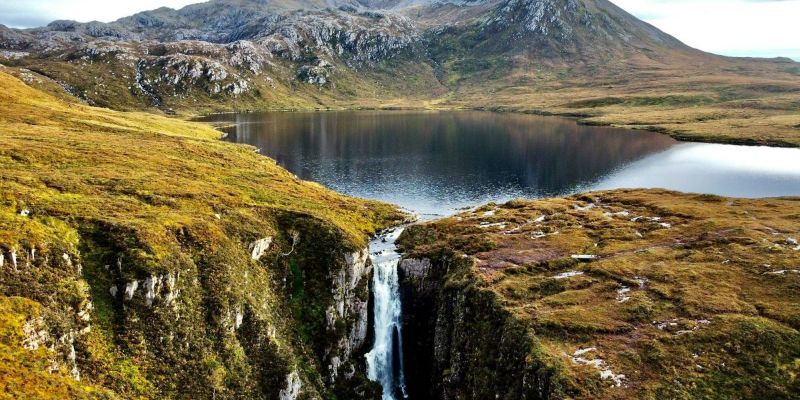
At a community meeting held by the local development trust a memorandum of agreement was signed between Transport Scotland, and the Hydrogen Port at Invergordon with Network Rail to investigate the installation of a new track from Garve to Durness that would be extended to Thurso to take advantage of the new developments in hydrogen power that were coming from the new Port at Invergordon. This came to fruition and work began in 2035 to develop an alternative NC500 based on Hydrail.
What's the science behind Hydrail?
The first prototypes for Scottish Hydrail used established battery technology through a hybrid configuration of hydrogen fuel cells, batteries and electric traction motors. The fuel cells converted hydrogen into electricity to feed the batteries as a stable power source for the traction motors. Initial public reactions to this type of technology ranged from those who were in full support, to others who were fearful of the technology due to safety and environmental concerns.
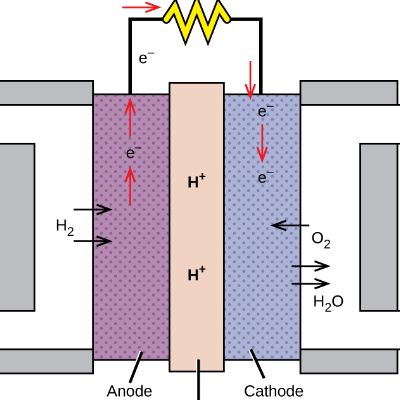
Basic flow chart shows the flow of water and electricity in and out of a Hydrogen-based fuel system. Image licence creative commons CC0.
Once initial tests had been run using battery cells on a pilot train from Garve to Kyle of Lochalsh a Citizen's Assembly was held on the future of Hydrail using hydrogen direct at source and an Act was passed in Parliament to supercede the Railways Act of 2005 in recognition that diesel and electric trains would soon be confined to the history books. The Hydrail Act of 2035 heralded a new programme for extensive investment in new lines, station hubs and refuelling depots at Invergordon Port. The first train, The Flying Selkie, came into service on 1st May 2040.
The train derives its name from an historic steam locomotive - The Flying Scotsman. This was the flagship locomotive for the London North Eastern Railway. In 1923 it first entered service and by 1934 had been recorded as the fastest steam locomotive in the World reaching speeds of over 100mph. A new era has been heralded with Scottish Hydrail that more than doubles this speed - The Flying Selkie borrows its name from a mythical sea creature famous in the history of the Gàidhealtachd.
A Selkie is a mystical creature that can transform from seal to human by shedding its skin. Originating in Scottish and Irish folklore, Selkies often come ashore, taking human form, but are bound to the sea. If their seal skin is hidden or stolen, they must remain on land until it's recovered. The name The Flying Selkie was picked by the Youth Citizen Assembly on Hydrail - it was chosen to represent links between culture, nature, land and water that would be embodied by this revolutionary form of transport.
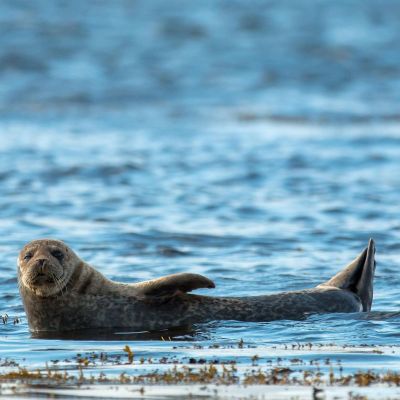
As I sit on the Scottish Hydrail watching the seals play in the Dornoch Firth its hard to imagine a time without it. My kids use it for their school trips to explore the peatbogs up at Forsinard, and I use it for my daily 15 minute commute to Inverness from Ullapool. Thankfully campervans and cars blocking the tourist hotspots of the NC500 have become something very much of the distant past and there is a new era of harmonious travel in the North.
But wait! This isn't true! Is this science fiction or science fact?!?!
Before you read on, there is a caveat. This a story set in the future written in the creative non-fiction genre. Creative non-fiction plays a pivotal role in science communication by transforming complex scientific concepts into accessible narratives, making expert knowledge more approachable for general readers. As one of the fastest-growing genres in publishing, creative non-fiction bridges the gap between scholars and the public by presenting true stories in a compelling, story-driven format. This method avoids jargon and buzzwords, which often alienate non-expert audiences, and instead uses clear, engaging language to convey ideas.
The genre is widely used in science storytelling to inform but also inspire, helping to democratize scientific knowledge and make it relevant to everyday life. In this case I wanted to draw upon the research conducted by Schneider-Mayerson et al. (2023). The authors posit that reading climate fiction may lead to several positive effects on attitudes and beliefs relating to climate action.
As Nalau and Cobb (2022) observe, climate change literacy can be strengthened by future visioning exercises and this has great potential to be explored through science communication. In this piece I focused on a practical problem in a location close to my home village. Tourism on the North Coast 500 (NC500) has become a focus for policy intervention due to its popularity and pitfalls. As cars and traffic increased on this popular route there have been calls for intervention to mitigate the impacts on sights of interest and the environment. Much of this has been documented in social media too, particularly on the NC500 The Land Weeps Facebook page.
In this piece I wanted to vision an NC500 that switched cars for trains. In Scotland Murray-Smith (2020) conducted desk-based research on possibilities for trains in the Highlands that can be fuelled using hydrogen. By developing more detailed, physics-based, sub-models of elements such as fuel cells, batteries, traction motors and power electronic components could be operated in rural routes in the Highlands of Scotland.
Currently there are trains that run on hydrogen battery cell locomotives operating in China, North America and Europe. Although the technology for Hydrail is nascent, and expensive, the concept has been tested and brought to market recently in Canada and this has compelling implications for Scotland which has a vast resource of untapped green hydrogen that can be produced using wind, waves and water.
This story envisions the initiation and upscaling of green hydrogen production at the Port of Invergordon in the North-Eastern Highlands of Scotland. This is no easy task, and there are cost implications and many nuances to understand. As Kemp (2024) writes in his discussion of the transition to a green economy in Scotland, "A Just Transition will require a great deal of fresh thinking, but too many Scots are unprepared for the change, and too few are set to truly benefit. Who will be the beneficiaries of this revolution? Only time will tell."
References
Kemp, K., 2024. Cui Bono? Scotland's Offshore Wind and a ‘Just Transition’. Scottish Affairs, 33(3), pp.355-364.
Murray-Smith, D., 2020. Modelling and simulation of hybrid electric trains powered by hydrogen fuel cells and batteries for routes in the highlands of Scotland: preliminary results.
Nalau, J. and Cobb, G., 2022. The strengths and weaknesses of future visioning approaches for climate change adaptation: A review. Global Environmental Change, 74, p.102527.
Schneider-Mayerson, M., Gustafson, A., Leiserowitz, A., Goldberg, M.H., Rosenthal, S.A. and Ballew, M., 2023. Environmental literature as persuasion: an experimental test of the effects of reading climate fiction. Environmental Communication, 17(1), pp.35-50.